
Data Center Liquid Cooling Built for the AI Era
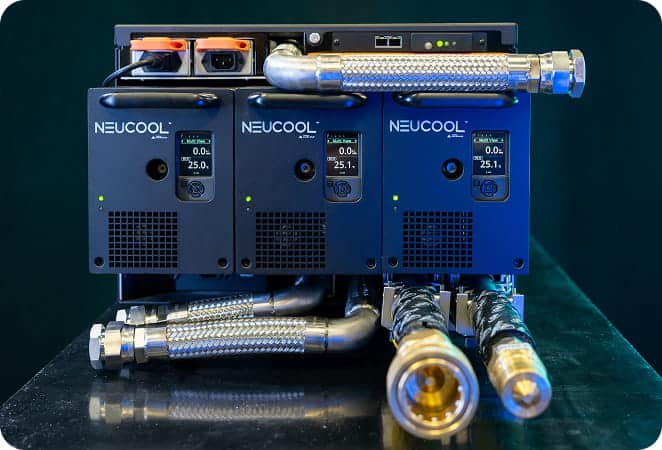
Air cooling has run out of headroom. Modern AI and HPC (high-performance computing) workloads push rack densities past 100kW, and the chips inside them now dissipate more heat per socket than any air-based system can practically remove. Data center liquid cooling has become the operational standard for any facility deploying next gen computers. Accelsius engineers two-phase, direct-to-chip liquid cooling for the mission critical data center, with measurable gains in thermal performance, energy efficiency, and total cost of ownership.
Why Data Centers Are Moving to Liquid Cooling
The shift to liquid cooling is driven by physics, not preference. A single NVIDIA H100 GPU produces over 700W of heat. A B200 produces even more. When you use eight of them per server and densify a row, traditional CRAC and CRAH units simply cannot keep pace. Fans run harder, hot spots multiply, and throttling kills the very performance the silicon was bought for.
Liquid removes heat roughly 1,000 times more effectively than air by volume. That means smaller thermal margins, predictable inlet temperatures at the die, and the ability to run accelerators at full TDP without degradation. For operators, the practical outcomes are higher rack density, lower PUE, reduced fan and chiller load, and a path to AI scale deployments without a ground up data center retrofit.
For a deeper look at the business case, see our blog on why every CIO should consider liquid cooling.
How Accelsius NeuCool Cools the Data Center
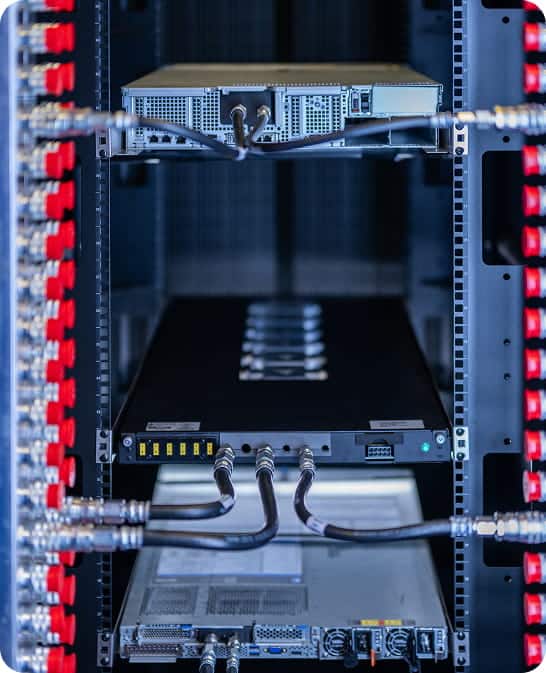
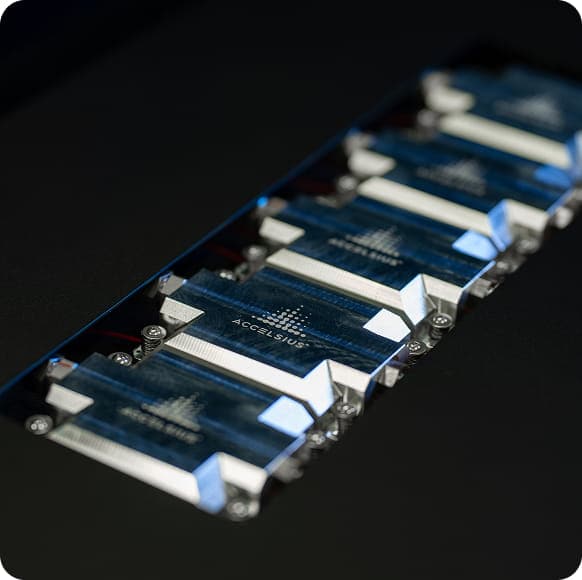
NeuCool is a direct-to-chip liquid cooling system with two phases. Heat is captured at the source (the CPU or GPU cold plate) by a low pressure dielectric refrigerant that boils on contact with the silicon. The phase change absorbs enormous thermal energy in a small volume of fluid, which is then condensed and recirculated. No water touches the equipment, meaning no immersion baths and no high pressure plumbing in the rack.
What that delivers in production:
- 4500W+ cooled per socket, with industry leading 0.020°C/W thermal resistance at 700W+ TDP
- 35% lower annual OpEx versus single phase direct-to-chip
- 8 to 17% lower TCO versus competing liquid cooling architectures, validated in independent Jacobs analysis
- Waterless, dielectric refrigerant with zero ozone depletion potential, ITE safe in the event of a leak
- Retrofit ready deployment in existing facilities, no white space rebuild required
Accelsius backs the system with NeuGuard, an enterprise grade support program, and a $100,000 per rack insurance commitment against cooling leak damage.
Two-Phase, Direct-to-Chip, or Immersion: What's the Right Architecture?
Operators evaluating data center liquid cooling typically narrow to three approaches.

Direct-to-chip, single phase.
Water glycol (PG25) passes through cold plates on the CPU and GPU. It’s a mature approach, but limited by the heat capacity of water and the operational risk of water-adjacent technology.

Direct-to-chip, two-phase.
A dielectric refrigerant boils at the cold plate. This has a higher heat flux, lower flow rates, smaller footprint, and no water risk. This is the Accelsius approach.

Immersion
cooling.
Servers submerged in a tank of dielectric fluid. It is effective at heat removal, but operationally heavy. Service procedures, fluid handling, and rack infrastructure all change.
Most operators rule out immersion on serviceability and rule out single phase on long term scalability. Two-phase direct-to-chip is the architecture purpose built for AI rack densities. We cover the trade offs in detail in Why Two Phase is the Winning Choice vs. Single Phase and A Closer Look at Two Phase Liquid Cooling.
Designed for the Mission Critical Data Center
Accelsius is North American based and built for the operational realities of modern data centers. Supply chain, support response, and partner ecosystem all sit close to the customer. NeuCool integrates with leading server platforms and is supported by a global partner network including Equus Compute Solutions, Computacenter, and IM Data Centers.
The system supports the silicon driving today’s AI buildout, such as Intel Sapphire Rapids and Emerald Rapids, AMD EPYC Genoa and Turin, NVIDIA Grace, and on the GPU side, NVIDIA H100, H200, B200, and AMD MI325X and MI355X.
Get Started with Accelsius
Whether you’re planning a greenfield AI facility, retrofitting an existing colo, or evaluating liquid cooling for the first time, our team will walk you through the architecture, the math, and the deployment path.