
by
Lucas Beran & Jordan Sutlive
This year, NVIDIA’s announcement that its liquid cooling can handle 45°C facility water was instantly praised as the new industry benchmark, a huge boon to both energy efficiency and resource conservation. “In favorable climates,” NVIDIA’s accompanying blog post stated, [45 degrees] can enable chiller-less operation with dry coolers, reducing facility cooling water consumption … to near zero.”
Let’s focus on the first part of that quote: “In favorable climates.” To be sure, 45°C greatly expands the ideal climate map for data centers, enabling many major cities to reduce their reliance on mechanical cooling. But “reduce” doesn’t mean “eliminate,” even under the most favorable conditions. With 45°C, you’ll still need to purchase a full mechanical plant to keep on standby. Otherwise, you may be left spraying your rooftops with gallons of water to maintain uptime during peak heat waves—as we’ve seen from facilities across London.
But if you’re able to achieve peak cooling with 50°C+ facility water? You’ve passed a key inflection point in data center economics; namely, the ability to eliminate mechanical chillers from your facility footprint. Past 50°C, and you’ve embarked on a whole new paradigm: a lowered PUE, a deferred chiller CapEx, and a greater allotment of power redirected to token production.
Last month, Accelsius proved this new paradigm is ready to be adopted by mission critical data centers. Our NeuCool solution delivers the same thermal performance at the processor as single-phase, except with 54°C Facility Water Systems (FWS)—or up to 59°C at higher flow rates. The results are conclusive: We have become the enabling technology for chiller-less AI factories.
Past 50°C, and you’ve embarked on a whole new paradigm: a lowered PUE, a deferred chiller CapEx, and a greater allotment of power redirected to token production.
40,000 ways to say 54°C
To prove we can run hotter water while preserving GPU performance, we relied on apples-to-apples testing by an independent third-party integrator. They measured 40,000 operating points with the same unmodified, commercially available hardware and the same workloads—only the cooling was swapped from a single-phase factory loop to a NeuCool retrofit. (To see the full methodology and breakdown of results, you can download our research paper here.)
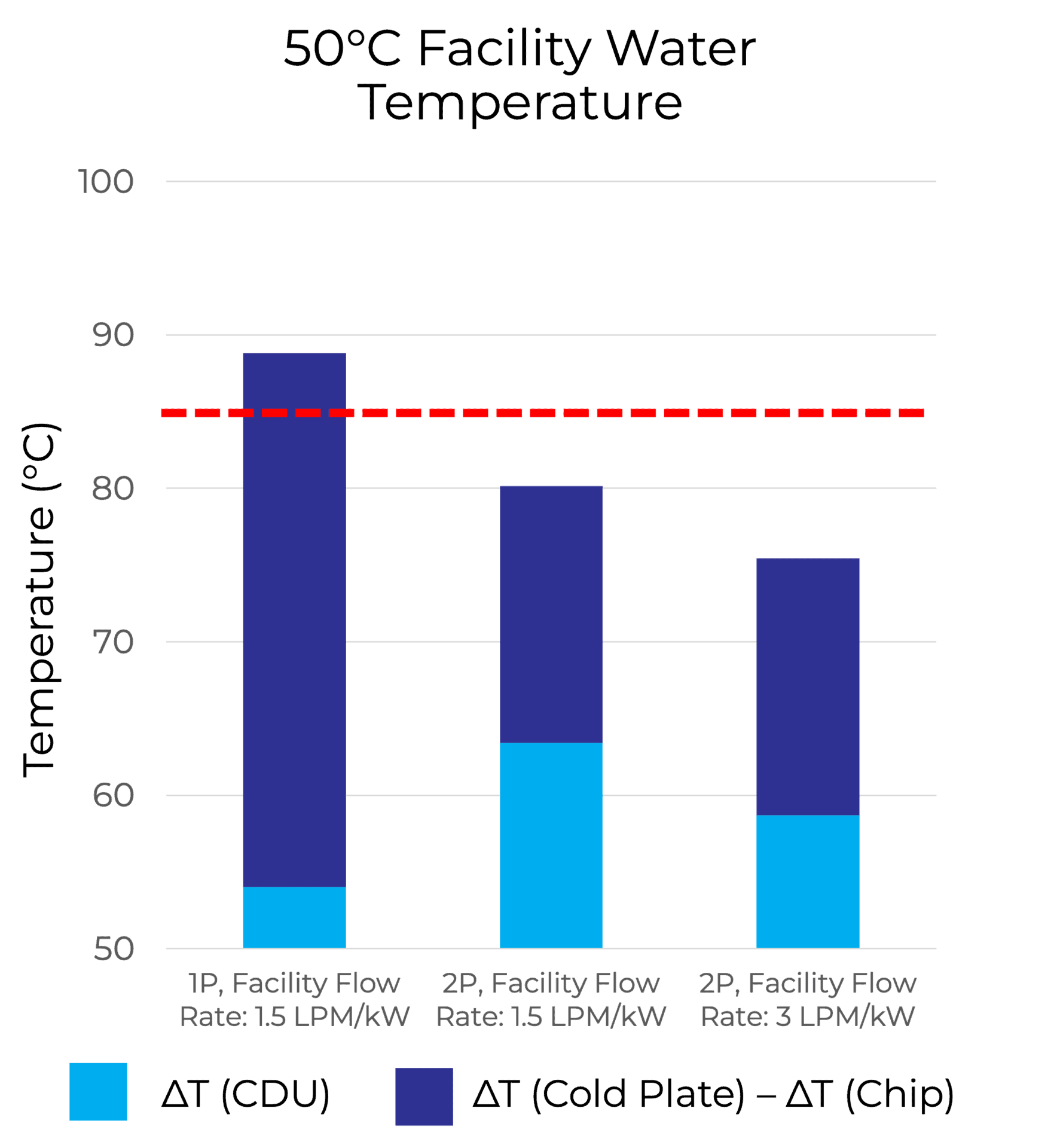
Not only did the test show the 9-14°C boost in thermal headroom at the full-system level as described above, but also a 19°C improvement in cold plate performance. Either way, these margins translate into year-round free cooling opportunities in most climates, even while accommodating future TDP and density increases from next-gen chips and racks.
This performance gap between single-phase and two-phase is largely thanks to the latter’s latent heat absorption. As two-phase refrigerants boil, they absorb greater levels of heat from their surroundings.
This latent heat absorption is the mechanism that makes “beyond 50°C” a possibility at all. Without phase change, single-phase cooling has to boost its flow rates to maintain performance at higher temperatures. Soon, those flow rate requirements will strain single-phase cooling architecture past the point of viability. Meanwhile, two-phase’s thermal runway is just getting started.
The test showed a 9-14°C boost in thermal headroom at the full-system level and a 19°C improvement in cold plate performance. These margins translate into year-round free cooling opportunities in most climates, even while accommodating future TDP and rack density increases.
From hours saved to infrastructure eliminated
The benefits of 50°C+ facility water are most apparent in hotter climates like Austin-San Antonio and Dallas-Fort Worth, which respectively require 73 and 129 hours per year of mechanically assisted cooling at 45°C. Cities situated in deserts like Phoenix display longer spans of mechanical dependency (at ~665 hrs/yr).
At 54°C, however, none of these cities would need chillers; free cooling could be enabled 100% of the year. It’s no coincidence that these are also the markets under the most grid pressure—exactly where eliminating chiller CapEx (instead of reducing runtime) would provide the greatest financial impact.
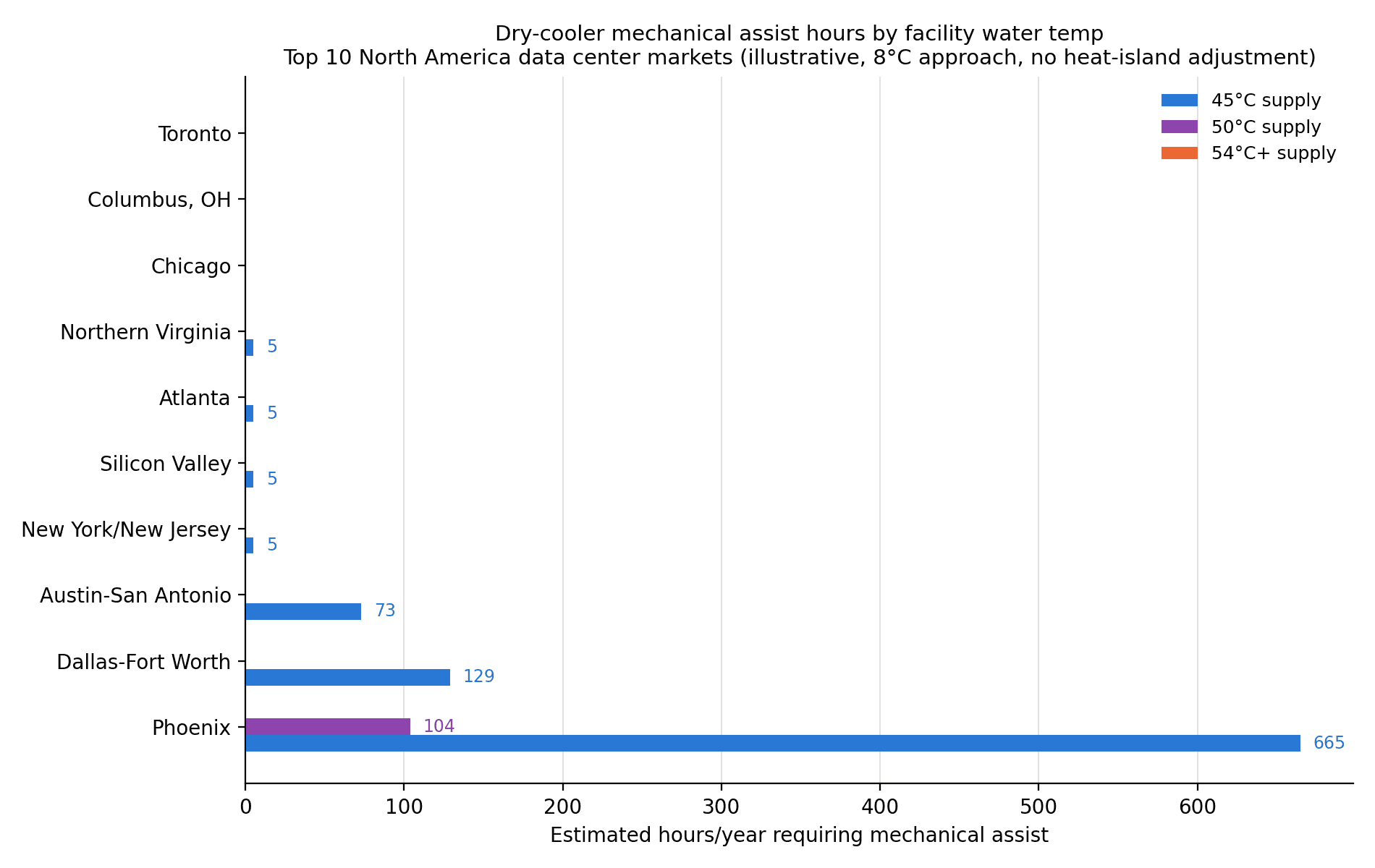
In many other major data center markets (such as Northern Virginia, Chicago, Atlanta, and the Silicon Valley), it’s true that 45°C eliminates the vast majority of annual hours that require mechanical cooling. So, in theory, going from 45°C to 54°C looks like it closes only a tiny sliver of hours (as few as 5 hrs/yr in the best markets).
However, that 5 hours is measured using averages—and our day-to-day reality rarely operates under average conditions. For example, the fact that data centers create “heat islands” is enough to push Northern Virginia’s 5 hours closer to 48 hours. Said another way, that’s enough to tip a facility from “occasional adiabatic assist” to “full mechanical CapEx.” 54°C+ headroom can absorb these swings, instead of leaving you exposed to climate variability.
Regardless of whether a facility needs 5 hours or 500 hours of chiller-assisted cooling per year, it still has to build, permit, and maintain an entire mechanical plant: the chillers, cooling towers, pumpings, piping, controls, and electrical distribution to support it. The CapEx for installation alone is up to $1M per 1MW, regardless of how few hours the mechanical plant has to run.
After installation, you’ll also need to ensure your equipment remains in peak condition—which becomes a burden precisely because it’s so rarely exercised—and train your crew so that they’re ready to activate “cooling crisis mode” with infrastructure that’s only used 1% of the year.
Consider it like this: would you buy and maintain a brand new car if you only needed to drive it one afternoon a year? If not, why would you do something similar for your data center?
45°C was never the finish line
The industry has treated 45°C as the finish line for cooling efficiency. However, the real finish line is transforming mechanical backup plants as an optional add-on instead of a costly inevitability.
With NeuCool, we’ve reached that goal. A 9-14°C thermal margin allows you to take control back from what the climate demands of your current cooling system. Yes, it allows you to avoid chillers—but it also maximizes your tokens per watt, and expands your margins for denser racks.
Now, the choice is yours. Do you want to bloat your CapEx with barely-used infrastructure? Or, with two-phase, would you rather unlock transformative advantages available to you all year long?
By now, it should be obvious: choose NeuCool.