

by
Accelsius
What NVIDIA’s announcement really means
This week’s news confirms one thing: it’s two-phase direct-to-chip’s time to shine.
On Tuesday, NVIDIA CEO Jensen Huang announced that its next-gen Vera Rubin supercomputers can be cooled with hot water—45℃, to be exact. This message was met with the widespread assumption that data center cooling is now less critical, that reducing the need for chillers means reducing the need for cooling itself.
But is that true? Servers still generate heat—more heat than ever before. That heat still needs to go somewhere; it’ll still need to be captured. Instead of signaling less cooling, the NVIDIA announcement identifies exactly where cooling will be emphasized going forward: not the chiller, but the chip.
While this means that all chip-level liquid cooling will outshine traditional cooling architectures, which are no longer viable at AI-scale power densities, there will still be clear winners and losers. Warmer water fundamentally reshapes how liquid cooling systems perform. Unlike single-phase direct-to-chip (1P D2C), for example, our NeuCool® two-phase direct-to-chip (2P D2C) technology unlocks its true potential when the water’s warmer. So we’re more than simply ready—we’re optimized to cool the future of AI data centers.
Here’s three key reasons why warmer water is better for 2P D2C:
With warmer water, 1P D2C has to double its flow—and halve its performance.
In a recent technical blog, NVIDIA stated that “Vera Rubin further increases [1P D2C] cooling efficiency by nearly doubling liquid flow rates at the same CDU pressure.” While an increase in flow rates can boost efficiency, it also carries many costs. Higher stress is inflicted on key components like cold plates, tubing, and connectors, escalating the rate of erosion—and, therefore, the risk of operational downtime.
Furthermore, if flow rate doubles and CDU pumping power isn’t doubled, 1P D2C’s cooling capacity is effectively cut in half. This translates to a hard scalability ceiling. Simply put, existing single-phase systems weren’t built for this newfound operating regime.
2P D2C, however? Because it relies on phase change (boiling its coolant to maximize heat capture), flow rate is not the primary performance lever. Even if two-phase flow rates may change slightly with a given thermal load, they won’t be materially impacted by higher facility water (FW) temperatures.
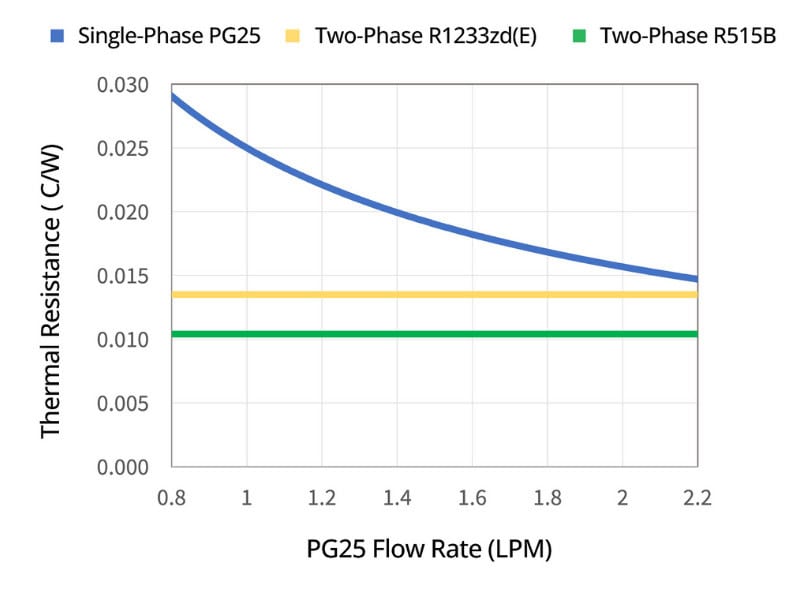
Higher facility water temperatures actually improve two-phase performance.
Warmer water causes stress for single-phase. However, it sets the stage for two-phase’s true potential.
Why? 2P D2C enables its coolant to boil into a vapor. In turn, higher FW temperatures increase this vapor’s density as it returns from the cold plate to the CDU. Denser vapor reduces drops in system pressure, improving circulation efficiency, cooling performance, and overall stability.
This boiling also decouples an AI chip’s temperatures from FW temperatures in ways that single-phase simply can’t. With 1P D2C, a 10℃ increase in FW temperature translates to approx. a 10℃ increase in chip temperature; however, 2P D2C’s latent heat capture means the same FW increase results in only a fraction of temperature rise for critical AI chips.
By now, it should be clear: what looks like a thermal penalty for single-phase instead unlocks two-phase’s superior performance.
NeuCool’s 6-8℃ thermal headroom opens the door for system-level benefits.
We’ve validated (and discussed elsewhere) our solution’s 6-8℃ thermal headroom, even in warmer-water environments. Alone, this headroom creates cascading benefits throughout the AI data center stack:
- Energy efficiency: With NeuCool, less energy needs to be diverted to facility water (and boosts free cooling frequencies up to 97% of the year in tropical countries like Singapore). This enables you to save energy, or reallocate it to additional GPU deployments.
- Lower TCO: Energy savings also translates to financial savings. Analysis from Jacobs Engineering has indicated that 2P D2C’s boost in thermal headroom results in 5-year TCO savings of 8-17% vs. single-phase.
- Flexible methods for heat rejection: Moving to a higher band of TW temperatures allows a wider variety of heat rejection infrastructure (such as dry coolers, cooling towers, and hybrid systems that prioritize free cooling). In Q2, we’ll be able to demonstrate NeuCool’s potential in dry cooler environments at partner innovation centers around the globe.
Warmer water doesn’t constrain two-phase. It unlocks it.
This week, NVIDIA announced that it’ll pull the entire industry into a temperature range where two-phase excels. Warmer facility water has an outsized positive impact not only on two-phase efficiency and overall adoption, but the industry’s desire for greater sustainability alongside a lower reliance on local water and energy. As AI data centers seek to balance performance and sustainability, they’ll need cooling that’s better aligned with AI-era physics.
This week, the future of AI data centers announced its arrival. This is what we’ve been building for.